
Walk into any showroom, and you will see dozens of slabs labeled under the generic umbrella of “granite.” However, matching two stones of different colors reveals that they behave like entirely separate materials. One might shrug off a red wine spill, while the other absorbs it instantly. At The Slab Depot, we believe that selecting the right surface requires looking past the colors and understanding the geological science underneath the surface.
The Geological Reality of Stone Hardness
In the commercial stone industry, the label “granite” is often used loosely to describe any hard, crystalline rock. True geological granite forms deep underground from cooling magma, consisting primarily of quartz and feldspar. These minerals score high on the Mohs hardness scale, making them resistant to scratches.
However, many exotic dark stones sold as granite are actually gabbro or anorthosite. These rocks contain different mineral blends that change how tightly the crystals lock together. A slab like Absolute Black is incredibly dense because its microscopic crystal matrix leaves almost zero gaps. Light-colored granites often feature larger, more separate crystal structures that possess higher natural porosity.
Why Microscopic Gaps Matter for Stains
Porosity refers to the percentage of empty room inside the stone’s structure. Imagine the slab as a dense sponge made of rock. Even though the surface feels completely flat and solid to your hand, microscopic pathways run between the mineral grains.
When you spill a liquid like olive oil or coffee, capillary action draws that fluid down into those tiny pathways. If the stone is highly porous, the liquid penetrates deeply, leaving a dark shadow that is difficult to lift. A stone with low porosity simply holds the liquid on the surface, giving you plenty of time to wipe it away before damage occurs.
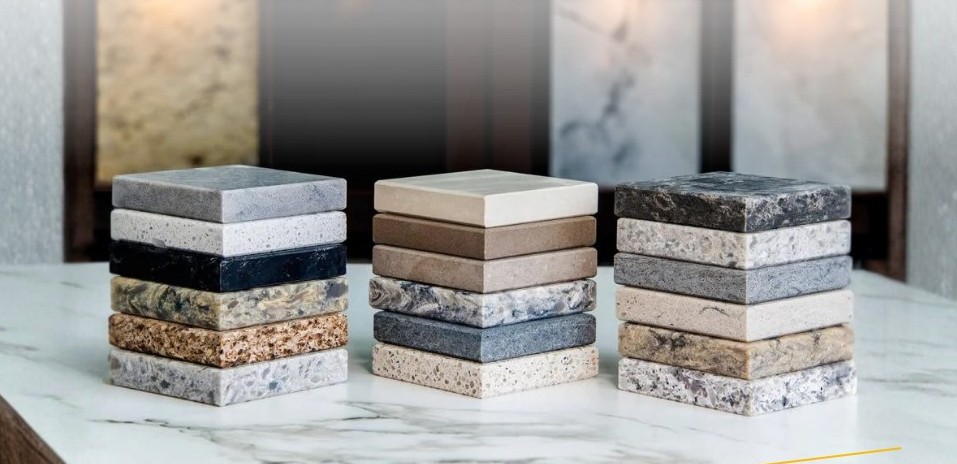
Decoding the Sealer Schedule Balance
Because porosity varies so wildly from one block of stone to the next, a generic “seal once a year” rule is inaccurate. Your maintenance routine must match the specific density of your chosen slab. High-density, low-porosity stones like Absolute Black granite require almost no sealer because the liquid cannot find a way inside. In fact, applying sealer to these dense surfaces often results in a hazy, sticky residue.
Conversely, lighter stones filled with large quartz pockets require a rigorous schedule. For these surfaces, a high-quality impregnating sealer must be applied every six to twelve months. The sealer works by filling the microscopic voids with specialized polymers, blocking the pathways so liquids cannot enter.
Testing Your Surface at Home
You do not need a laboratory setup to find out where your counter stands on the porosity spectrum. The easiest way to determine your maintenance routine is the simple water droplet test.
Pour a tablespoon of water onto an unsealed section of your counter and note the time. If the water creates a dark ring within five minutes, your stone is highly porous and needs immediate protection. If the water sits on top as a perfect bead for half an hour without darkening the stone, you are working with a highly dense material that requires minimal upkeep. Matching your care routine to the actual physics of the rock ensures your investment remains pristine.